

Updated · 17 min read
Nine auto transport CRMs that brokerages actually shortlist, who each one is built for, and what it costs at two, five and ten agents.
The short answer. The best auto transport CRM for a brokerage depends mostly on how many agents you run and how much of the workflow you want in one system. For a brokerage that wants the whole operation in one system, TruxCRM is an official Central Dispatch partner with every feature in one plan, and it has the lowest published price at five agents: $120 to $150 per month. For a one- or two-person office, CargoFlare's Basic plan is cheaper at $99. For a large outbound sales floor, Message Plane has the most built in. If you want a carrier marketplace attached to your software, look at Super Dispatch.
Quick picks
- All-in-one CRM with Central Dispatch built in: TruxCRM, an official Central Dispatch partner
- Lowest price at five or ten agents: TruxCRM, $120–150 a month for five
- Lowest price for one or two users: CargoFlare Basic, $99 a month for two
- Most built in for a large sales floor: Message Plane
- Carrier marketplace from the same vendor: Super Dispatch
- Quoting engine built on years of rate data: ProABD
- Carriers and fleets rather than brokers: CarShipIO
1. Auto transport CRM comparison table
The whole field on one screen: who each platform is built for, how it is priced, and the published price.
| CRM | Best for | Pricing model | Published price |
|---|---|---|---|
| Message Plane | Large outbound sales floors | Base fee plus per user | $399–499 + $79/user |
| Super Dispatch | Brokers who want a carrier marketplace | Per product | Shipper from $159 |
| ProABD | Brokerages that quote at volume | Per user, plus implementation | $349.95 + $39.95/user |
| BATS | Simple Central Dispatch posting | First user plus per user | $200 + $50/user |
| Cronetic | Posting to several boards | Base plus per agent, three tiers | From $149 + $29/agent |
| CargoFlare | One- and two-person offices | Seats included, then per user | $99 for 2 users + $25/user |
| CarShipIO | Carriers and fleets | Per truck | $10–159, then $30/truck |
| DispatcherPro | Routing leads from many sources | Unpublished | Ask the vendor |
| TruxCRM our product | All-in-one at a flat price, from independent brokers to growing teams | Per company, 5 agents included | $120–150, then $20/agent |
The price column only means something once it is worked out at your own headcount, because these vendors do not charge on the same basis. That arithmetic is in section 12.
2. How we evaluated these platforms
We did not score these products against each other. A single score would hide the thing that matters most, which is that they are built for different brokerages. Each platform was checked against the same seven questions instead:
- Price at a real headcount. The published price worked out at two, five and ten agents with the same arithmetic, not the headline figure.
- One record from lead to delivery. Lead, quote, signed order, dispatch and invoice on the same shipment, rather than copied between screens.
- Lead intake. Whether quote requests from your website land in the CRM on their own, tagged with the channel that produced them.
- Customer communication. Whether quotes, signature requests and invoices go out from your own domain.
- Carrier risk. Where carrier insurance is recorded and whether the software notices when a policy expires.
- Commercial terms. Contracts, implementation fees and free trials, where the vendor publishes them.
- Who it is really for. Brokers, carriers, dealers or all three, judged by how the product is priced as much as by what its marketing says.
What we did not do: we have not run a paid trial of every product, we have no affiliate relationship with any vendor here, and nobody paid to be included. Prices come from each vendor's own pricing page where one exists. Where a vendor does not publish a price, we name the third-party listing we used, and that figure is less reliable than a vendor's own page.
3. Message Plane: best for large outbound sales floors
The most feature-dense option on this list, and priced to match. Calling, texting, dispatch, VIN decoding, carrier verification, card processing and load board posting all come in the box instead of being sold as add-ons.
Strengths
- The phone system lives inside the CRM, which changes the working day of a team that dials all day.
- Month to month, with no mandatory contract.
- Per-user price steps down as the team grows: $79, then $69 from 11 users, then $59 from 20.
Watch out for
- The base fee is charged before a single seat, so a small team pays a lot per person.
- If you already pay for a phone system you like, part of the price covers something you will not use.
Price: a base fee of $399–499 per month plus $79 per user per month for teams of one to ten. Its price structure is the opposite of most of this list: expensive for a small team and increasingly reasonable for a large one.
4. Super Dispatch: best if you want a carrier marketplace attached
The biggest name in the category and the one most brokers have heard of. It is really two products, a carrier TMS and a shipper/broker TMS, connected by one of the industry's largest load boards.
Strengths
- The marketplace. Finding a carrier and managing the load happen in the same system.
- A serious carrier-side product, which matters if you also run trucks.
Watch out for
- If you are buying it purely as a CRM, you are paying for a network you may not need.
- Pricing depends on which product you buy, and larger deployments are quoted after a demo.
Price: Super Dispatch lists Carrier Pro from $55 per seat per month and the shipper product from $159 per month. See their pricing page for current figures.
5. ProABD: best for brokerages that quote at volume
One of the longest-established broker platforms, built around its own quoting engine. Transport Auto Quoter prices a lead instantly from configurable zones and years of accumulated auto transport rate data.
Strengths
- Quoting speed and consistency across a team, which is where ProABD started.
- Dispatch to both Central Dispatch and Super Dispatch from inside the platform.
Watch out for
- Implementation is quoted separately and can be substantial: the same listing that carries the price estimates it at $2,000 to $50,000. Ask what it costs for your brokerage before you commit to the demo.
Price: ProABD is listed at $349.95 per month for one user, with additional users at $39.95. That figure comes from a third-party listing, not from ProABD's own site.
6. BATS: best for simple Central Dispatch posting
A broker-focused CRM with a direct Central Dispatch API, an automated pricing engine, and email and SMS campaigns built in.
Strengths
- Load board posting is one click instead of copy and paste.
- Marketing sequences against your lead list without a second tool.
Watch out for
- The per-user price is steep. Five people is $200 plus four at $50, so $400, double the headline figure.
Price: BATS is listed at $200 per month for the primary user, then $50 per additional user.
7. Cronetic: best for posting to several load boards
A broker CRM with a strong load board story. Posting and dispatching to Central Dispatch is a button inside the order, and the same workflow reaches Truckstop, uShip and DAT.
Strengths
- Several load boards from one place, useful if your carriers do not all live on Central Dispatch.
- Texting and voice minutes are included on the higher tiers.
- A free trial with no credit card required.
Watch out for
- Three tiers with different per-agent rates, so the plan you need decides the price more than the headline does.
- Each plan's base price includes one user, so every agent after the first is charged.
Price: Cronetic publishes three plans: Professional at $149 per month plus $29 per agent, Premium at $199 plus $49 per agent with 500 texts and five hours of calling, and Enterprise at $249 plus $69 per agent with 2,500 texts and twelve hours of calling.
8. CargoFlare: best for one- and two-person offices
A newer CRM aimed at brokers and dealerships, with a modern interface and AI features on the higher tier: an email writer and an SMS assistant.
Strengths
- The cheapest published entry point on this list for a very small team, with two users included on the base plan.
- A 60-day risk-free trial with no credit card required.
- A 25% discount for paying annually.
Watch out for
- Central Dispatch integration is limited on Basic. Full integration, the customer portal and workflow automations need the Professional plan.
- When we checked, the home page and the pricing page showed different figures. We used the pricing page. Confirm the number in writing.
Price: CargoFlare's pricing page lists Basic at $99 per month with two users and Professional at $199 per month with four users. Extra users on either plan are $25 per month. Enterprise is quoted by sales.
9. CarShipIO: best for carriers, not brokers
Included because it appears on nearly every list like this one, which confuses buyers. CarShipIO is strongest as carrier software: trips, a driver app, an electronic bill of lading with photo inspections, and IFTA reporting.
Strengths
- An excellent fit for hauling fleets and owner-operators.
- A fifteen-day free trial with no card required.
Watch out for
- There is broker functionality, but pricing by truck tells you who the product is really for. A broker has no trucks to count.
Price: CarShipIO is priced by truck: $10 per month for a single truck with fifty cars, $39 for an owner-operator, $89 for two to three trucks, $159 for four to five, then $30 per truck after that.
10. DispatcherPro: best for routing leads from many sources
An all-in-one CRM aimed squarely at car shipping brokers. It handles lead capture, automatic distribution to sales staff by custom rules, quoting and dispatch, and integrates with both major load boards.
Strengths
- Rules-based lead distribution, for brokerages where leads arrive from several sources and need to reach the right agent quickly.
Watch out for
- No published price. That is not a red flag on its own, but get the number in writing at your headcount before you invest time in a migration.
Price: unpublished. You have to ask.
11. TruxCRM: all-in-one CRM and official Central Dispatch partner
This one is ours, so read it with some scepticism and check every claim against the pricing page.
We think TruxCRM is the best all-in-one auto transport CRM for small, medium and growing brokerages, and the best value from five agents upwards; the arithmetic in section 12 is most of the reason. For a one- or two-person office, CargoFlare's Basic plan is cheaper on price alone, and we would rather you knew that now.
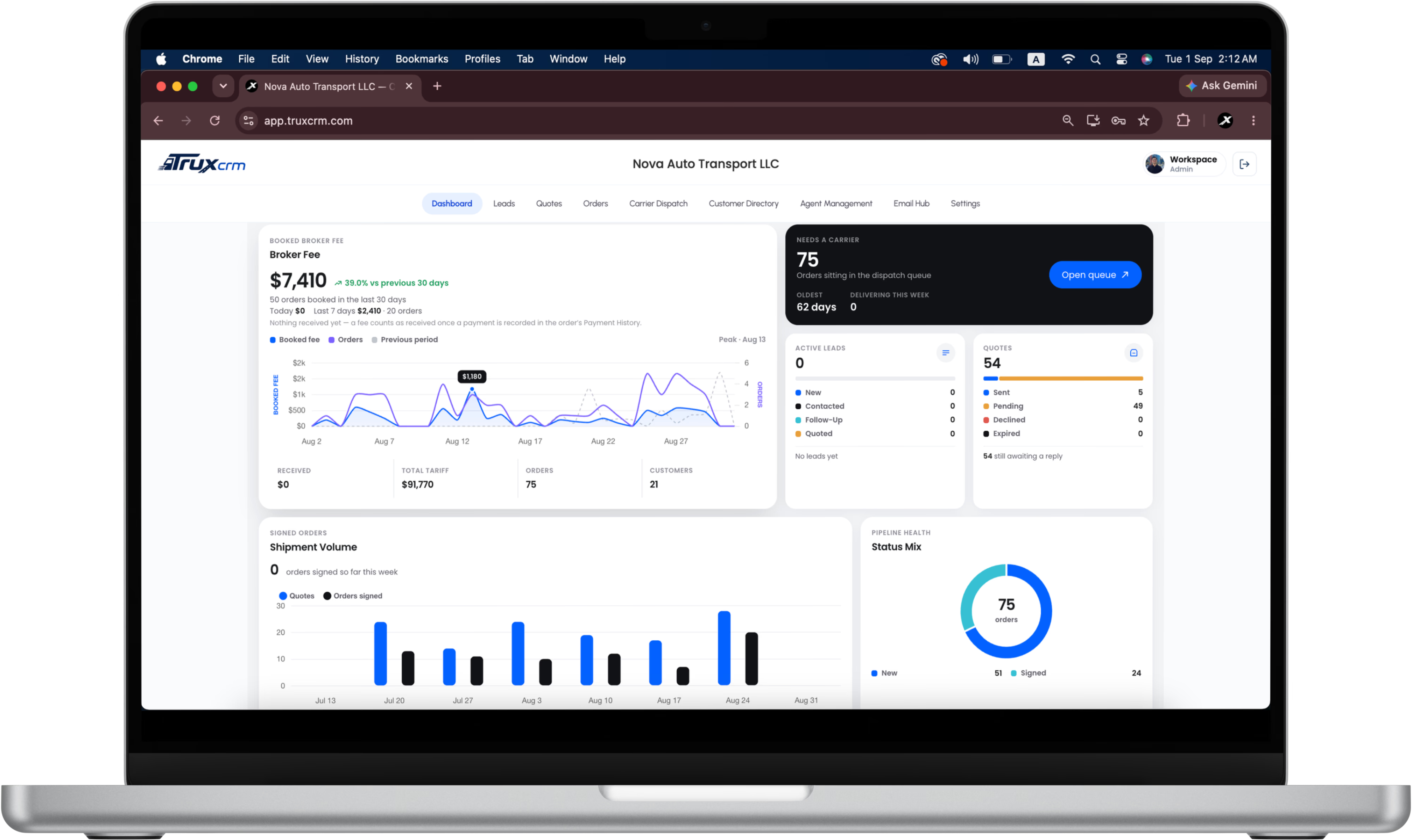
TruxCRM is one plan with everything in it: leads and lead sources, a quote form for your own website, CSV lead import with bulk or even assignment to agents, quoting with broker fee and carrier pay held separately, route maps and VIN import, email follow-ups, customer e-signature, Central Dispatch search and posting, carrier dispatch and insurance tracking, invoicing and payment records, tasks and file attachments, advanced search filters, agent roles, reporting, and email sent from your own domain. There are no tiers, and nothing is held back for a bigger package.
Strengths
- The lowest published price at five and ten agents on this list, with every feature included.
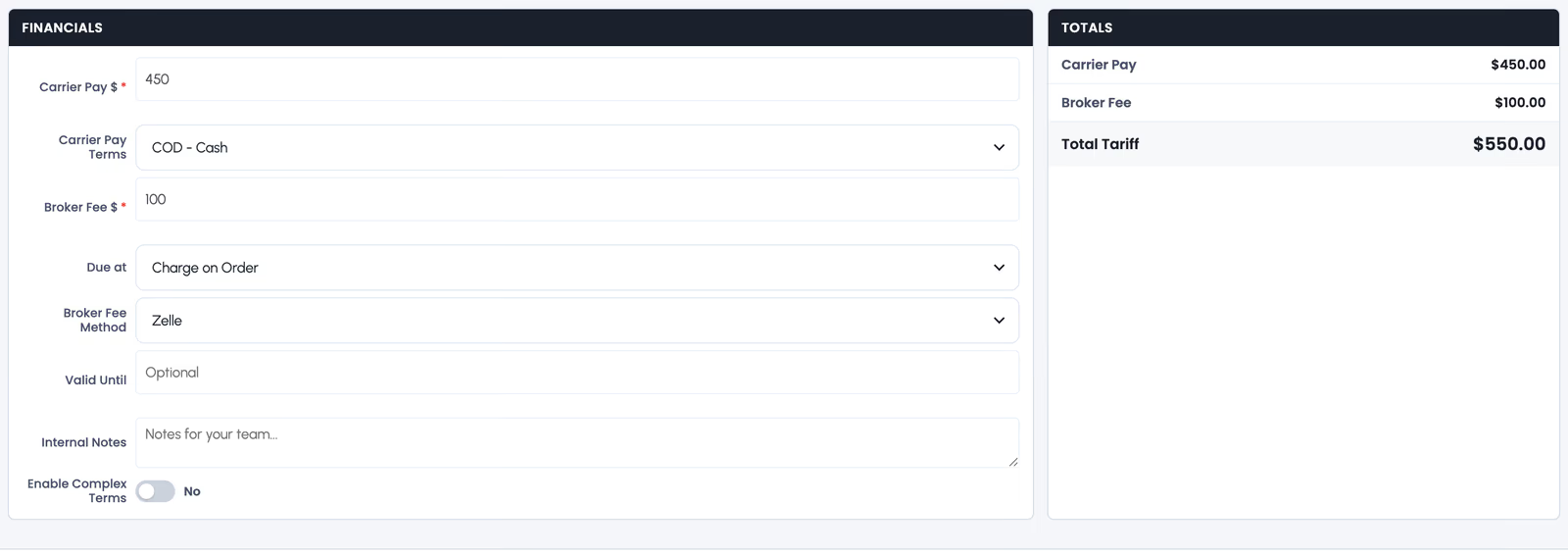
- Broker fee and carrier pay are separate fields on every quote and order, so the margin on each car can be read off the record instead of calculated later.
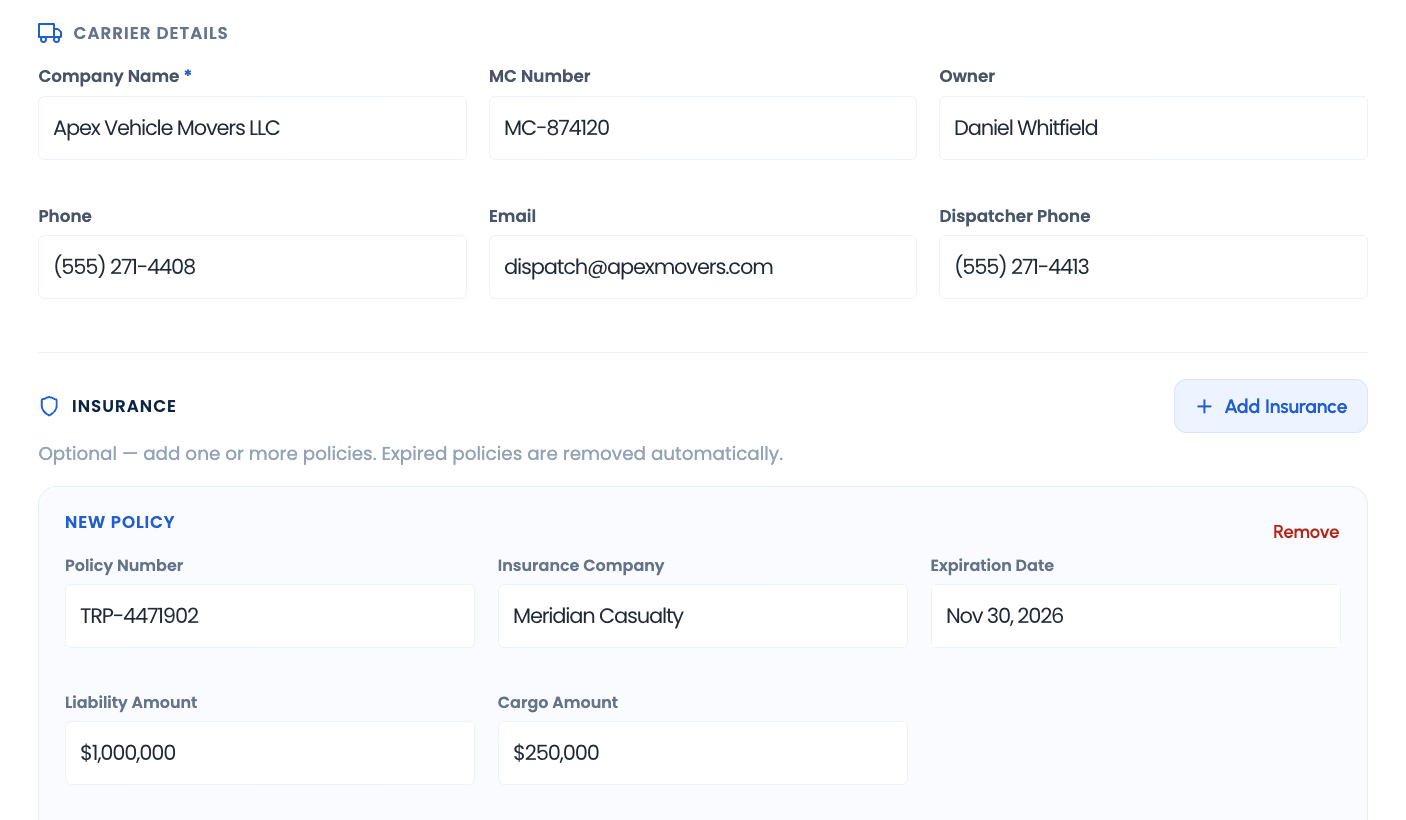
- Carrier insurance is recorded per policy with an expiry date, and expired policies drop off the carrier automatically.
Good to know
- TruxCRM is an official Central Dispatch partner. You connect your own Central Dispatch account, then search it and post loads from the order.
- Five agents are included before any per-agent charge, so a team can grow to five without the bill moving.
- Lead capture forms for your website are included, with no limit on the number of forms.
- Quotes, signature requests and invoices go out from your own domain. Our free email setup guide covers SPF, DKIM and DMARC for the major hosts.
Price: $120 to $150 per month for up to five agents, then $20 per additional agent. Where you sit in that range depends on whether you turn on Truxie AI, the optional read-only assistant.
12. What two, five and ten agents actually cost
This is the section that headline prices hide. The same arithmetic is applied to every vendor's published figures: monthly price, every agent paying, no annual discount, no add-ons.
These are CRM subscriptions only. A brokerage also pays for a load board, and often for e-signature and a phone system on top — we price the whole auto transport broker software bill separately, because the CRM is one of four lines on it, and card processing can cost more than all four together.
| CRM | 2 agents | 5 agents | 10 agents | How it is worked out |
|---|---|---|---|---|
| TruxCRM | $120–150 | $120–150 | $220–250 | Five agents included, then $20 each |
| CargoFlare Basic | $99 | $174 | $299 | Two users included, then $25 each |
| CargoFlare Professional | $199 | $224 | $349 | Four users included, then $25 each |
| Cronetic Professional | $178 | $265 | $410 | One user included, then $29 per agent |
| BATS | $250 | $400 | $650 | $200 first user, then $50 each |
| ProABD | $390 | $510 | $710 | $349.95 first user, then $39.95 each, plus implementation |
| Message Plane | $557–657 | $794–894 | $1,189–1,289 | $399–499 base, plus $79 per user |
| Super Dispatch | Varies | Varies | Varies | Priced per product. Carrier seats alone are $275 for five |
| CarShipIO | n/a | n/a | n/a | Priced per truck, not per agent |
| DispatcherPro | Ask | Ask | Ask | Unpublished |
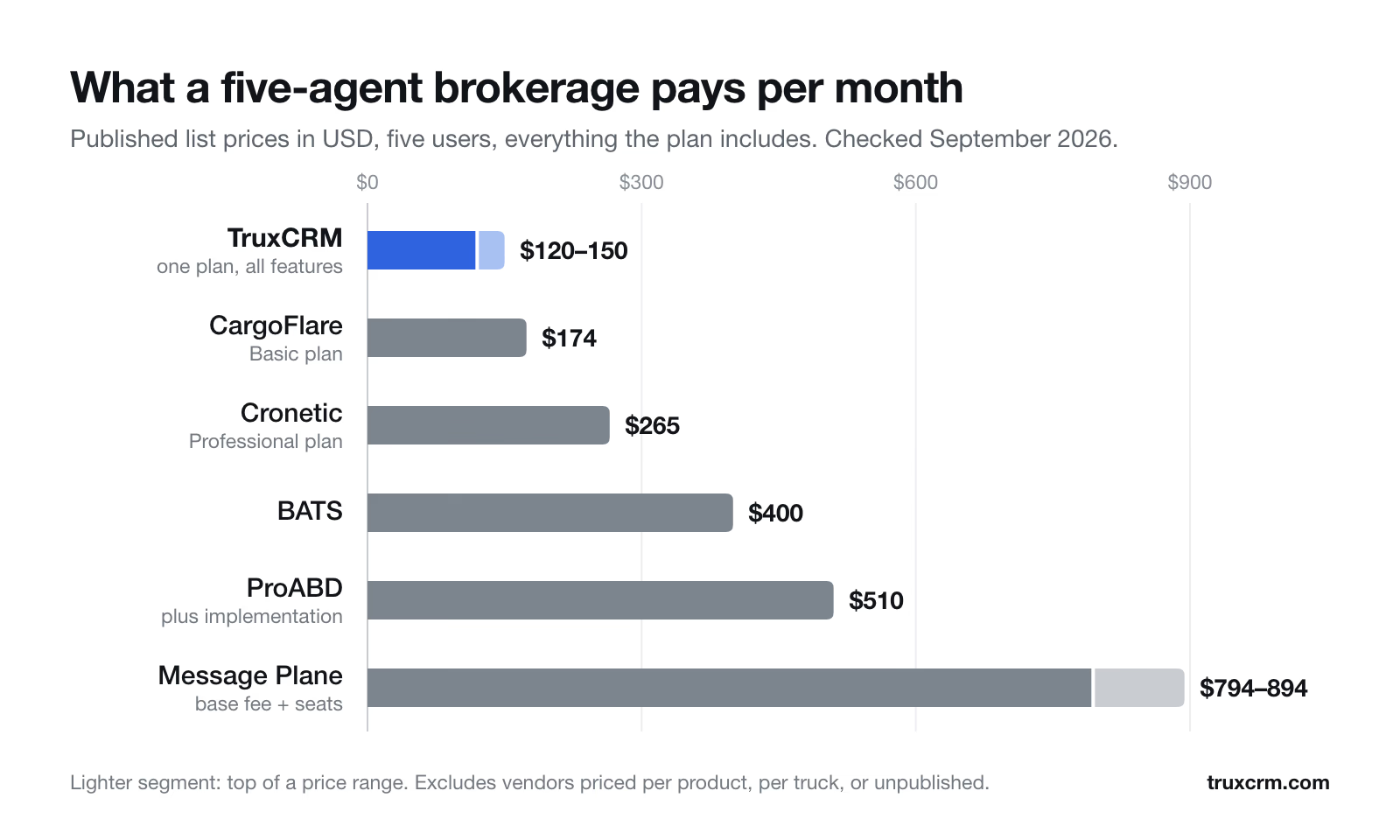
Three things stand out. First, the order changes with team size. CargoFlare is the cheapest for two people, and TruxCRM is the cheapest from five upwards, because its five included agents cover a team that other vendors charge per head. Second, base fees punish small teams. Message Plane costs at least $278 per person at two agents, and $119 to $129 per person at ten. Third, per-truck pricing is not comparable at all. A roundup that puts CarShipIO's $159 next to a broker CRM's $159 is comparing two different units.
Two caveats matter more than the table. Price is not value: if the expensive product removes a bottleneck that is costing you loads, it is the cheaper choice. And verify every figure. Pricing pages change, plans get renamed, and some of these numbers come from listings instead of the vendor's own page. Every link above goes to the source we read.
13. Auto transport CRM vs HubSpot, Salesforce or Zoho
Plenty of brokerages start on a general-purpose CRM, and some stay there. It can work. The question is how much of the business you are willing to squeeze into custom fields.
A general CRM models a deal: a company, a contact, a value and a close date. A vehicle shipment is a different shape. It has a VIN, a pickup window, an origin and a destination, and a broker fee kept separate from carrier pay, where the difference between the two is your margin. It also has a signed order, a dispatched driver, a carrier insurance certificate that has to be valid on the day the car moves, and an invoice that has to reconcile against what the customer actually paid.
A general CRM makes sense if you already run one across a larger business, have someone to maintain the customisation, and handle dispatch and invoicing in other tools. HubSpot's free CRM is a reasonable place to keep a contact list.
A specialised auto transport CRM makes sense for most brokerages, because the record already matches how a car moves and none of it needs building. Our buying guide goes through what a broker CRM has to carry, field by field.
14. CRM, TMS or load board: which one do you need?
These three terms are used loosely, and vendors often sell some combination of them, so it helps to separate the jobs:
- A CRM handles the customer side: leads, quotes, follow-up, the signed order and the customer's history.
- A TMS (transportation management system) handles the movement: dispatch, driver details, bills of lading, pickup and delivery dates.
- A load board is a marketplace where you find a carrier for the car. Central Dispatch and Super Dispatch are the best-known examples in auto transport.
A broker CRM built for auto transport usually covers the CRM job and much of the TMS job on one record, so the customer side and the movement live in one system instead of two that have to agree with each other.
15. How to choose in five steps
- Count your agents for next year, not today, and read the section 12 table at that headcount.
- Check that broker fee and carrier pay are separate fields. One combined price means the margin on every car is worked out later, if at all. Why that matters.
- Ask how website quote requests reach the CRM, and whether each lead is tagged with the ad or page that produced it.
- Ask where carrier insurance lives and what happens when a policy expires between dispatch and pickup. Our guide to vetting an auto transport carrier explains why this matters more than most buyers think.
- Run one real car through the demo, from lead to delivered, without leaving the record. Our buying guide has eight questions that work on any vendor, including us.
One more check that catches people out: which domain does customer email come from? If quotes go out from a platform address, your customer sees someone else's name on your most important message. If they go out from your own domain, the domain has to be authenticated, or the quotes land in spam.
16. Frequently asked questions
Which auto transport CRMs work with Central Dispatch?
Several of the CRMs here connect to Central Dispatch. TruxCRM is an official Central Dispatch partner: you connect your own Central Dispatch account, then search it and post loads from the order, with the carrier and dispatch record kept on the same shipment. BATS has a direct Central Dispatch API, Cronetic posts and dispatches to Central Dispatch from the order, ProABD dispatches to Central Dispatch and Super Dispatch, and CargoFlare's full Central Dispatch integration is on its Professional plan. In every case the Central Dispatch subscription is paid to Central Dispatch.
What is the best auto transport CRM for a small brokerage?
For a brokerage of three to ten agents that wants every feature at one price, TruxCRM has the lowest published cost: $120 to $150 per month for five agents, then $20 per agent. For one or two people, CargoFlare Basic at $99 per month for two users is cheaper.
How much does auto transport CRM software cost?
For a five-agent brokerage, published prices in September 2026 ranged from $120 to $150 per month (TruxCRM) to $794 to $894 per month (Message Plane). Most vendors charge a base fee plus a per-user fee, so the only useful comparison is the total at your own headcount.
Can I use HubSpot or Salesforce as an auto transport CRM?
You can, with custom fields for the vehicle, route, carrier pay and broker fee, and separate tools for dispatch and invoicing. It suits brokerages that already run a general CRM and have someone to maintain it. Most brokerages are better served by a CRM whose records already match how a vehicle shipment works.
What is the difference between an auto transport CRM and a TMS?
A CRM manages the customer side: leads, quotes, follow-up and the signed order. A TMS manages the movement: dispatch, driver details, bills of lading and delivery dates. Most broker software built for auto transport covers both on one shipment record, and a load board is a separate marketplace for finding carriers.
Which auto transport CRMs have a free trial?
When we checked, Cronetic offered a free trial with no credit card required, CargoFlare a 60-day risk-free trial with no card, and CarShipIO a fifteen-day free trial with no card. We did not find a published free trial for the others. TruxCRM offers a private demo run on your own brokerage's workflow.
Which auto transport CRM is the cheapest?
It depends on team size. At five and ten agents, TruxCRM has the lowest published price of the vendors compared here: $120 to $150 per month for five agents and $220 to $250 for ten, with every feature included. For one or two users, CargoFlare Basic starts at $99 per month. Vendors that do not publish prices could not be compared.