


· 12 min read
The short answer. Start as a broker unless you already drive trucks for a living. A brokerage needs FMCSA broker authority ($300), a $75,000 bond that usually costs around $900 to $3,000 a year, a process agent and a phone, and most people open one from home for roughly $1,300 to $4,000. A car hauling company needs a truck, a trailer and first-year insurance that commonly runs $16,000 to $25,000 on its own. Short on money for either? Sell for an established brokerage first, under its license.
Most people who search for this picture a truck. That makes sense. Car shipping looks like a trucking business from the outside. But most of the companies a customer finds on Google when they search "ship my car" don't own a single truck. They're brokers. They sell the move, price it, and hire a carrier who does the driving.
Both are real businesses, and both can work. They just cost wildly different amounts to start, and they fail in different ways. This guide covers both, starting with the choice that sets everything else.
1. Broker or car hauler: pick your lane first
A broker arranges the move. The customer books with you, you find a licensed carrier for the car, and you keep the difference between what the customer pays and what the carrier gets. A carrier owns or leases the truck and physically moves the car. Same industry, very different businesses.
| Question | Broker | Car hauler (carrier) |
|---|---|---|
| What you do all day | Sell, quote, book carriers, keep the customer updated | Load, drive, deliver, keep the truck legal |
| FMCSA authority | Broker authority plus a $75,000 bond or trust | Motor carrier authority plus liability insurance |
| Money to get started | Roughly $1,300 to $4,000 | Tens of thousands, mostly truck, trailer and insurance |
| Biggest running cost | Load board, phone, CRM and leads | Insurance, fuel, repairs, truck payment |
| CDL needed | No | Often. Class A once the truck and trailer are rated 26,001 lbs or more and the trailer alone over 10,000 lbs |
| What usually goes wrong | No carrier takes the car at your price, cancellations, slow cash | Damage claims, breakdowns, empty miles, insurance renewals |
Pick the broker lane if you're good on the phone, you don't have much capital, and you'd rather manage problems than drive through them. Pick the carrier lane if you already hold a CDL, you like the road, and you have money (or credit) for equipment. Plenty of companies end up doing both: a carrier can add broker authority later to sell the loads it can't fit on its own trailer.
2. The cheapest legal ways to start
You can learn this business for close to nothing before you spend a dollar on a license. Here are the routes that actually stay inside the rules:
- Sell for a licensed brokerage as an agent. You quote and book under their authority, their name and their contract, and you're paid a share of the broker fee. No bond, no filing fees, and you learn pricing on someone else's account. Federal rules say brokerage has to be done in the name the authority is registered under (49 CFR § 371.7), so you sell as them, not under your own brand. Check their authority is active on SAFER and get your commission in writing.
- Dispatch for one carrier. FMCSA's 2023 guidance says an agent who works for a single carrier isn't choosing between carriers, so it isn't acting as a broker. Start dispatching for several carriers and deciding who gets which load, and you've crossed into brokering. Handling the shipper's money points the same way. Keep it to one carrier, or get licensed.
- Run the brokerage from home. You don't need an office. FMCSA asks for your principal place of business, so plan on a real street address, and many small brokers simply use their own.
- Ask the surety about payment plans. The bond is the biggest single cost. Some sureties spread the premium over months. It's worth one phone call.
- Don't buy leads in week one. Shared leads look cheap, often a dollar or so each, but the same request can be sold to as many as ten brokers. Learn to quote and close on the free channels in section 7 first.
3. Starting a brokerage, step by step
Here's the order that keeps you from paying for things before you need them. The full walkthrough of the FMCSA part, screen by screen, is in our guide to getting an auto transport broker license.
- Form the business. Most brokers use an LLC. State filing fees run from about $50 to $500. Get a free EIN from the IRS and open a business bank account in the company's name.
- Make a Login.gov account and verify your identity. FMCSA's Motus system uses it, and you'll need a government photo ID.
- Apply in Motus for a USDOT number and broker authority. The fee is $300 per authority and it isn't refundable.
- Get the $75,000 financial security. Almost everyone uses a BMC-84 surety bond. The surety files it with FMCSA for you.
- Hire a process agent to file your BOC-3. Usually $25 to $100. You can't file it yourself.
- Wait for the authority to go active. Your application is published, anyone can protest it for 10 days, and the bond and BOC-3 must be on file within 90 days or the application is dismissed. Most clean applications take three to eight weeks.
- Register with UCR. Brokers pay the smallest bracket: $46 for 2026 and $55 for 2027.
- Set up the tools. A phone line, a website with a quote form, a load board to find carriers, a CRM to track leads and orders, a carrier agreement, customer terms, and e-signature.
Do steps 1 to 6 before you spend anything on step 8. A website and a CRM are no use until your authority is active, and you can't legally take a booking before then.
4. What a lean brokerage costs to open
| Item | Cost | How often |
|---|---|---|
| LLC filing | $50 to $500, by state | Once, plus any state annual fee |
| EIN | Free | Once |
| FMCSA broker authority | $300 | Once |
| BOC-3 process agent | $25 to $100 | Usually once |
| BMC-84 bond ($75,000) | About $900 to $3,000 | Every year |
| UCR registration | $46 (2026), $55 (2027) | Every year |
| Central Dispatch Core | $139.95 plus tax | Monthly |
| CRM | From $120 (TruxCRM, up to five agents) | Monthly |
| Business phone | About $15 to $20 per user | Monthly |
Add it up and the one-time and first-year costs land between about $1,300 and $4,000. Where you fall mostly depends on your credit, because that sets the bond premium. After that, the basic tools run around $280 a month, before any money spent on leads or ads. If you want the full monthly picture at five agents, including e-signature and card fees, see what auto transport broker software really costs.
5. Starting a car hauling company
Being honest here: this is the expensive path. You can do it, and good carriers are always in demand, but go in with a budget, not a hunch.
Authority. You apply in Motus for a USDOT number and motor carrier authority (also $300), file a BOC-3, and register with UCR by fleet size. Your insurer files proof of liability cover with FMCSA.
Insurance. The federal minimum is $750,000 of public liability for a for-hire truck rated 10,001 lbs or more (49 CFR § 387.9). Brokers and shippers usually expect $1,000,000 and a separate cargo policy, because the federal cargo minimum has been suspended since 2019. Insurance brokers quote new car hauling authorities at roughly $16,000 to $25,000 for the first year, and it varies a lot by state and driving record. Get real quotes before you buy a truck. Our guide to vetting an auto transport carrier shows what brokers will check on you.
Equipment. Two common ways in:
- Hotshot: a dually pickup and a two- or three-car wedge trailer. The cheapest start. Watch the weight ratings: if the truck and trailer together are rated 26,001 lbs or more and the trailer alone over 10,000 lbs, you need a Class A CDL (49 CFR § 383.91). Many three-car setups cross that line, so read the plates before you buy.
- Full-size car hauler: a tractor with a seven- to nine-car trailer. More cars per trip and more revenue per mile, but a far bigger loan and insurance bill, and always a CDL.
One industry guide puts total hotshot startup costs, including truck, trailer, insurance and a cash reserve, at about $49,000 to $134,000.
Safety rules. New carriers are monitored for their first 18 months, with a safety audit during that time (49 CFR § 385.307). CDL drivers also mean drug and alcohol testing, Clearinghouse queries, medical cards and hours-of-service logs.
The cheaper carrier route: lease on to an established carrier. You drive under their authority, usually on their insurance, for a share of each load, while you learn the lanes and build a record. Then you get your own authority.
6. How one car shipping job makes money
Here's a normal brokered job from start to finish:
- A customer asks for a quote. You price the route, the vehicle and the timing.
- They accept, sign the order and pay a deposit. For most brokers, the deposit is the broker fee.
- You post the car on a load board like Central Dispatch at a price a carrier will take.
- A carrier accepts. You check their authority and insurance, then send a dispatch agreement.
- The driver picks up, inspects the car with the customer and signs the bill of lading.
- At delivery, the carrier is paid its share, often cash or check on delivery.
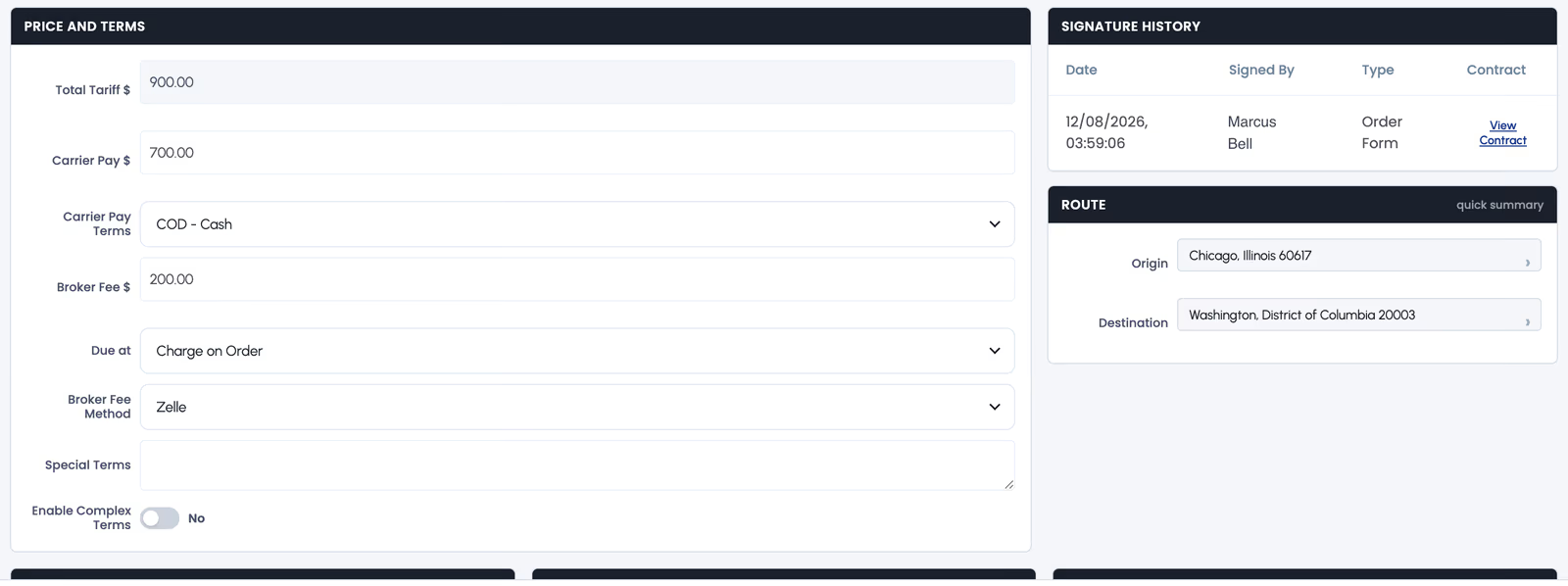
One marketplace's worked example puts a typical broker margin at around 25%: on an $850 move, about $637 goes to the carrier and about $213 stays with the broker. Smaller jobs have smaller fees. On a $550 order with $450 of carrier pay, you keep $100. We break that split down in broker fee vs carrier pay.
The classic beginner mistake is quoting low to win the customer. The customer is happy, the car gets posted, and no carrier will touch it at that price. Two weeks later the car is still sitting and the customer cancels. Price to what carriers will accept on that lane, not to beat the cheapest quote on the internet.
7. Your first customers without a big ad budget
Paid ads in car shipping are expensive and you're bidding against brokers with years of reviews. Start with channels that cost time instead of money:
- A Google Business Profile. It's free. Ask every happy customer for a review. Reviews are what new brokers lack most.
- Independent car dealers. Small used-car lots sell online to out-of-state buyers all the time and need someone to ship the car. One good dealer can send you cars every week.
- Snowbirds. Retirees moving south for the winter, then back north in spring. It's a predictable wave every year, and they book early.
- People who are moving. Moving companies that don't ship cars, real estate agents, and military families on a PCS move all need car shipping and can refer you.
- Your own quote form, answered fast. Every lead from your website is yours alone. Call back within minutes. The studies behind that rule are in how fast to call back an auto transport lead.
When you do buy leads, start small, call each one within minutes, and judge the provider on cost per booked order, not cost per lead.
8. Mistakes that sink new car shipping businesses
- Calling yourself a carrier when you're a broker. Federal rules require a broker's advertising to show it's a broker (49 CFR § 371.7). Customers find out when a different company's truck shows up.
- Dispatching a carrier you didn't check. Hijacked MC numbers and double brokering are common. Check authority and insurance on FMCSA's own records every time.
- Letting the bond slip. Since January 2026, if a claim pulls your bond below $75,000, FMCSA can suspend your authority within days unless you restore it.
- Keeping no records. Brokers must keep a record of every transaction for three years, and either party can ask to see it (49 CFR § 371.3).
- Running it all from an inbox and a spreadsheet. It works for ten leads. At fifty, quotes go unanswered and follow-ups get missed. That's money walking out the door.
That last one is where TruxCRM comes in. It keeps every lead, quote, e-signed order, carrier and payment on one record, posts loads to Central Dispatch straight from the order (we're an official Central Dispatch partner), and costs $120 a month for up to five agents. It's built for exactly this stage: a new brokerage that wants to look established from the first customer. Book a free demo once your authority is on the way.
9. Frequently asked questions
How much does it cost to start an auto transport business?
A one-person brokerage usually costs about $1,300 to $4,000 to open: the $300 FMCSA fee, a $75,000 bond at roughly $900 to $3,000 a year depending on credit, a BOC-3 filing, UCR registration and an LLC. Basic tools then run about $280 a month. A car hauling company costs far more, because the truck, trailer and first-year insurance alone often reach tens of thousands of dollars.
Can I start a car shipping business with no money?
Close to it. Work as a sales agent for a licensed auto transport brokerage, selling under its authority and name for a share of the broker fee. You learn pricing and carriers without paying for a bond or filing fees, and you can get your own authority once you have savings and a few customers.
Do I need a CDL to become an auto transport broker?
No. Brokers don't drive, so no CDL is needed. You need FMCSA broker authority, a $75,000 bond or trust, a BOC-3 filing and UCR registration. A CDL only matters if you run your own trucks, and then usually a Class A once the truck and trailer are rated 26,001 lbs or more.
Can I run an auto transport brokerage from home?
Yes. Most small brokerages start from home with a phone, a laptop and a load board. FMCSA asks for a principal place of business, so use a real street address, and check whether your city wants a home business license.
How long does it take before I can book my first car?
Usually three to eight weeks from applying in Motus. Your application is published, there's a 10-day protest window, and your bond and BOC-3 must be on file before the authority goes active. You can't legally take a booking until SAFER shows the authority as active.
How much do auto transport brokers make per car?
It depends on the lane and the vehicle, but one marketplace's example puts the broker share at around 25%: about $213 on an $850 move. Smaller local moves often carry fees closer to $100. What you keep is the customer total minus carrier pay, so pricing carriers will actually accept matters more than the headline quote.