

· 12 min read
Every article about auto transport broker software prices the CRM and stops there. That is the smallest line on the bill, and the only one anybody argues about.
1. What counts as auto transport broker software
"Auto transport broker software" is not one product. It is the set of tools it takes to move a car from an enquiry to a paid invoice, and most brokerages assemble it from three or four vendors without ever adding up the total.
Strip out the branding and a brokerage needs five jobs done:
- Capture and quote. A lead arrives, someone prices the move, a quote goes out.
- Get it signed. The customer agrees to a price and a set of terms, in writing, in a way that holds up later.
- Find a carrier. Post the load, take the calls, check the authority and the insurance.
- Dispatch and track. Assign the driver, record the dates, tell the customer what is happening.
- Invoice and collect. Charge the customer, pay the carrier, and know what the margin was.
A CRM built for this industry covers most of that. What it does not cover, you buy separately — and those separate pieces are where the money quietly goes.
2. The four lines on the bill
Priced at five agents, in September 2026, a brokerage's monthly software bill has four recurring lines and one percentage.
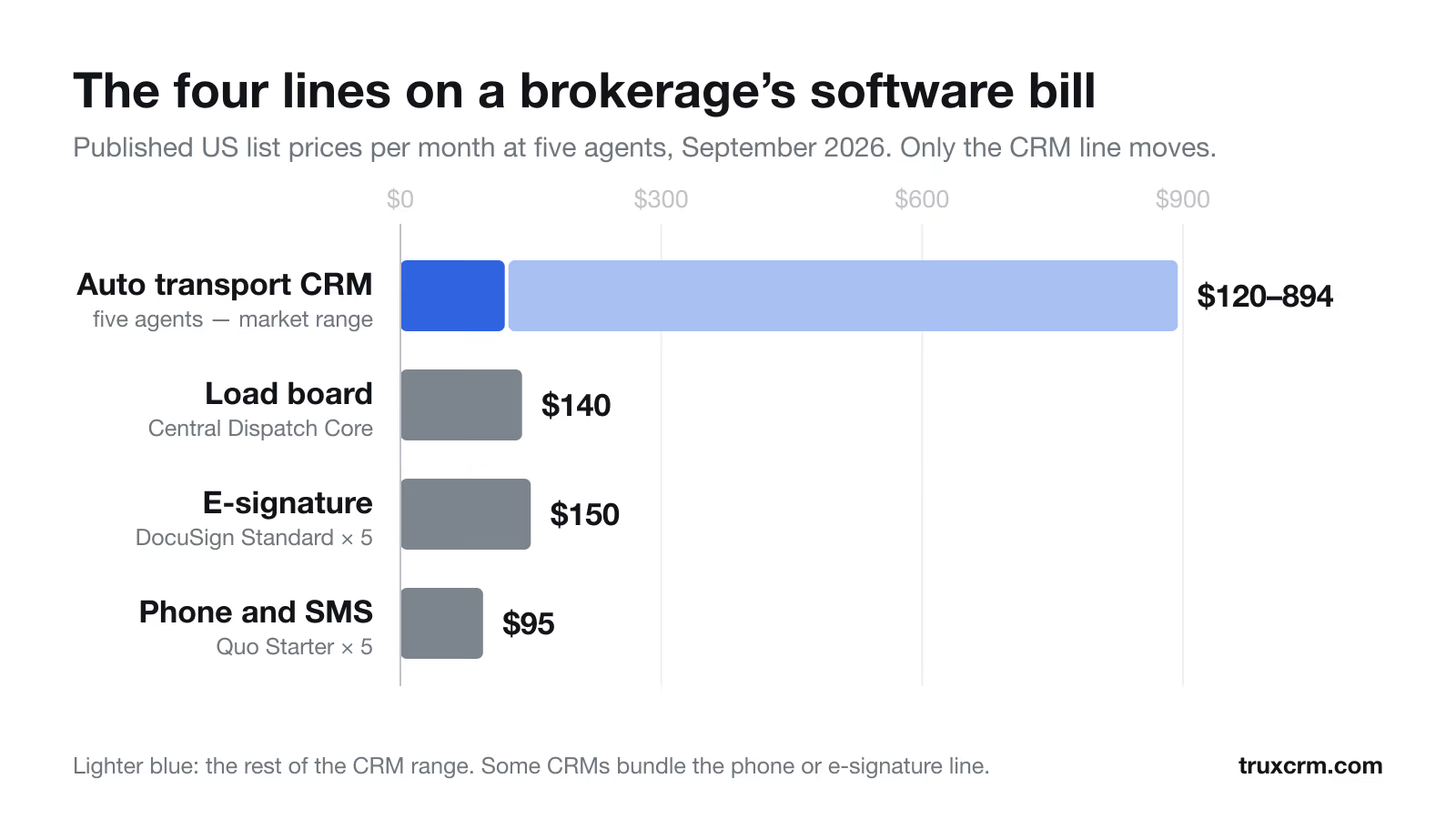
That is the shape of the problem. The load board, the e-signature tool and the phone system cost roughly the same whoever you are. The CRM is the one line you actually choose — and depending on which you choose, it can be smaller than any of the other three or larger than all of them combined.
3. The CRM line: $120 to $894 at five agents
This is the line the roundups cover, so we will be brief. We priced nine platforms at two, five and ten agents in a separate comparison of auto transport CRM software, with each figure linked to the vendor's own pricing page. At five agents the published prices ran from $120 to $894 per month.
The reason the spread is so wide is that the category does not price on one axis:
- Base fee plus per seat. Message Plane publishes $399–499 per month plus $79 per user. Cronetic starts at $149 plus $29 per agent.
- First seat, then per seat. BATS is listed at $200 for the first user and $50 for each after.
- Seats included, then per seat. CargoFlare includes two users for $99, then $25 each.
- Per truck. CarShipIO prices on fleet size. That is carrier software; it appears in broker roundups anyway.
- Per product. Super Dispatch sells shipper and carrier products separately, from $159 per month on the shipper side.
Two of those models look identical at one seat and diverge violently at ten. This is the single most common costing mistake in the category: comparing headline numbers at the size you are now, and signing a contract that prices your hiring plan.
4. The load board line: $139.95
Central Dispatch is where most vehicle loads get posted, and a brokerage pays for it directly. Its published shipper plans are $139.95 per month for Core and $214.95 for Premium, plus tax.
Worth understanding clearly: this is a carrier-sourcing subscription, not an operating system for your business. It tells you who might move the car. It does not quote, it does not hold your customer's signature, and it does not tell you what the load earned. Brokers who treat the load board as their system of record end up reconstructing margin from memory, which is where the margin quietly goes.
Budget it as a fixed cost of doing business, the way you budget your MC authority or your surety bond. It is not a variable you optimise.
5. The e-signature line: $150, and the limit nobody reads
Here is the one that catches people. DocuSign publishes Standard at $30 per user per month and Business Pro at $45, billed annually. Five agents on Standard is $150 a month.
But the price is not the trap. The envelope allowance is. Standard and Business Pro both include 100 envelopes per user per year. Five agents share 500 signed documents a year, or about 42 a month across the whole brokerage.
A brokerage booking 100 orders a month blows through that allowance in the first five months and pays overage for the rest of the year. And that is counting one envelope per order — before any re-send, any amended price, any second vehicle added to the same booking.
6. The phone line: about $95 for five
Agents need a number that is not their mobile, calls that get logged, and texts that reach customers. Two ways to buy it.
Per seat. Quo (formerly OpenPhone) publishes Starter at $19 per user per month, or $15 billed annually, with unlimited US and Canada calling and messaging. Five agents is $75–95. Business-grade systems from the larger vendors run higher, and their published rates move often enough that you should price your own seat count rather than trust a number in an article.
Per message. If texting runs through an API instead, Twilio publishes $0.0083 per SMS in and out on a US long code, with carrier fees of roughly $0.0035 to $0.007 per message on top. Call it two cents a text all in. That sounds like nothing until you count the pickup confirmations, delivery windows and payment reminders on a few hundred orders a month.
Whichever route, the number that matters is not the rate. It is whether the call and the text land on the order record automatically, or whether an agent has to remember to write down what was said.
7. Payments: a percentage, not a line
Card processing is not a subscription, so it never shows up in software comparisons — and for most brokerages it is the largest number on this page.
Stripe's published US rate is 2.9% plus 30¢ per successful domestic card transaction. On a $900 vehicle move that is $26.40. A brokerage running 100 card-paid orders a month is paying about $2,640 in processing — several times the entire software stack above it.
You are not going to negotiate that away at small volume, and cards are what customers want to use. But it does reframe the argument. If a CRM costs $200 more per month than the cheapest option and it stops two orders a month falling through the cracks, it has already paid for itself several times over on margin alone. Software is the cheap part of this business. Optimise it, but do not let it eat the week.
8. What a five-agent brokerage actually pays
Adding the recurring lines, excluding card processing:
| Line | Lean | Typical | Heavy |
|---|---|---|---|
| Auto transport CRM | $120 | $265 | $794 |
| Central Dispatch (Core) | $140 | $140 | $140 |
| E-signature | included | $150 | $150 |
| Phone and SMS | $95 | $95 | included |
| Monthly total | $355 | $650 | $1,084 |
| Per agent | $71 | $130 | $217 |
Lean uses a CRM that includes e-signature. Heavy uses a CRM that includes calling and texting. Card processing is excluded throughout because it scales with revenue, not headcount.
Three honest observations about that table.
First, the gap between lean and heavy is about $730 a month, or $8,760 a year. For a five-person brokerage that is a real number — roughly a junior agent's payroll taxes, or the marketing budget for a quarter.
Second, the CRM you pick moves the total more than every other decision combined, which is why it deserves the research even though it is not the biggest cheque you write.
Third, and least convenient: the cheapest total is not automatically the right answer. The heavy column buys a large outbound calling operation, which is the correct purchase if your growth comes from agents dialling all day. It is a waste if your leads arrive through your website and you need quoting and paperwork, not a dialler.
9. One vendor or four?
The pitch for an all-in-one platform is that the pieces already talk to each other. The pitch for assembling your own is that each piece is best in class and you are not held hostage.
In this industry the all-in-one argument is stronger than usual, for one specific reason: a vehicle move is a single record that four different tools all want to own. The quote knows the price. The signed order knows the terms. The dispatch knows the driver. The invoice knows what was paid. When those live in four systems, keeping them in agreement is somebody's job, and it is a job nobody was hired to do.
The failure mode is not dramatic. It is a carrier turning up for a car whose order was amended in the CRM but never re-signed, or an invoice going out for the original quote rather than the revised one. Every brokerage that has run a split stack for a year can tell you a version of that story.
Assembling your own makes sense when you have a genuinely unusual requirement — a dealer portal, an auction integration, a volume of loads that needs custom routing — and someone whose job includes owning the seams. Below about fifteen agents, that person does not exist, whatever the org chart says.
10. Where TruxCRM fits
We are a fit for a small to mid-sized brokerage that wants one predictable monthly bill and every feature switched on. One plan, no tiers: $120 to $150 per month covering up to five agents, then $20 for each agent after that.
Against the four lines above, what that includes:
In the subscription
- Lead capture forms for your own website, tagged with the source they came from
- Quotes that hold broker fee and carrier pay as separate numbers, so margin is a fact rather than a calculation
- Customer e-signature on the order — the $150 line above, with no envelope ceiling
- Carrier dispatch with driver details and insurance expiry the system watches
- Invoices, payments and balances against the same record
- Branded domain email, so quotes leave from your address rather than a platform's
- Agent roles and permissions, dashboard and brokerage reporting, and Truxie AI for asking operations questions in plain English
The honest framing: at five agents we are the smallest CRM line in the table, and the e-signature line disappears into the subscription. You will still pay Central Dispatch directly, the same as everyone else, and you will still pay your card processor.
If that shape fits, put your own workflow in front of us and price it against whatever you run today.
11. Pricing your own stack in five steps
- Write down the headcount you expect in twelve months, not today's. Every per-seat model is priced against that number.
- Price each CRM at that headcount using its published model, not its headline. Our nine-vendor comparison has the arithmetic already done at two, five and ten agents.
- Ask each vendor which of the four lines it includes. E-signature, calling, texting and load board posting are bundled by some and billed separately by others. Get it in writing before the demo ends.
- Add the lines it does not include at your seat count, and compare totals. This is the only comparison that means anything.
- Check what leaving costs. Contract length, notice period, and whether you can export your orders and customers in a format you could actually import somewhere else.
Step three is where the real differences surface, and it is the question vendors answer least willingly. If you want a sharper set, our guide to choosing auto transport CRM software has eight questions designed to be awkward on a demo call — and they work on us too.
12. Frequently asked questions
How much does auto transport broker software cost per month?
For a five-agent brokerage in September 2026, a full stack ran from about $355 to $1,084 per month on published list prices. That covers the CRM, a Central Dispatch subscription at $139.95, e-signature and a phone system. Card processing is on top and typically dwarfs all of it: Stripe's published US rate is 2.9% plus 30¢ per transaction.
Is auto transport broker software the same as a CRM?
No. The CRM is one component. "Broker software" in practice means the CRM plus a load board subscription, an e-signature tool and a phone system — unless the CRM bundles some of those. The CRM is the largest variable, ranging from $120 to $894 per month at five agents, while the other lines barely move between brokerages.
Do I have to pay for Central Dispatch separately?
Yes. Central Dispatch is a subscription you hold in your brokerage's name, published at $139.95 per month for the Core shipper plan and $214.95 for Premium, plus tax. Treat it as a fixed cost of operating, like your authority or your bond, rather than something a software choice changes.
Can I run a brokerage on a general CRM like HubSpot or Salesforce?
You can, with custom fields, and brokers do. A general CRM models a deal: a company, a contact, a value, a close date. A vehicle move has a VIN, an origin and destination, a pickup window, a broker fee separate from carrier pay, a signed order, a carrier insurance certificate that must be valid on the day the car moves, and an invoice to reconcile. The cost is not the subscription — it is that the deal record and the operational reality drift apart, and nobody notices until a carrier arrives for a car that was never confirmed.
What is the cheapest way to run a small brokerage?
At one or two people, a CRM with seats included is usually cheapest: CargoFlare Basic publishes $99 per month for two users. From roughly three agents upward, a flat plan that covers a team wins, because per-seat pricing compounds with every hire. Either way, pick the CRM that includes the most of the four lines — a slightly higher subscription that absorbs the e-signature bill is cheaper than a lower one that does not.
Does e-signature really need its own subscription?
Only if your CRM does not include it. DocuSign's Standard plan publishes at $30 per user per month with 100 envelopes per user per year — five agents share 500 signed documents annually, which a brokerage booking 100 orders a month exhausts inside five months. A CRM that signs orders natively removes both the subscription and the ceiling.