

· 9 min read
The short answer. There's no special car shipping license. What you need is FMCSA property broker authority, the same "MC number" freight brokers hold. Since May 2026 you apply for it in Motus, FMCSA's new registration system, with a verified Login.gov account. You pay $300, file a $75,000 bond or trust, get a process agent to file a BOC-3, and register with UCR every year. With decent credit the whole thing costs about $1,300 to $2,000, and authority usually goes active three to eight weeks after you apply.
The phrase "auto transport broker license" sends a lot of people looking for a course, an exam or some special car shipping permit. None of those exist at the federal level. The license is a registration, and the hardest part is getting the order of the steps right so nothing stalls.
This guide walks through every step in that order, with what each one costs, what can hold it up, and what to do the week your authority goes active.
1. What the license actually is
Under federal law, a broker is anyone who, for money, arranges or offers to arrange transportation of property by an authorized motor carrier (49 CFR § 371.2). Cars are property. So if you take a customer's booking and hire a carrier to move the car across state lines, you're a broker, and you need broker operating authority from FMCSA.
When it's done you'll have three things:
- A USDOT number, which identifies your company with the Department of Transportation.
- An MC number, the docket number for your broker authority. Motus changed how you apply, not the number itself, so ignore posts claiming MC numbers are gone.
- Active broker authority, shown publicly on FMCSA's SAFER system. That's what carriers and load boards check.
There's no exam and no required course. You don't need a CDL, because brokers don't drive. And if you only sell for an existing brokerage, under its name and its authority, you don't need your own at all.
2. What to have ready before you apply
- Your business entity and EIN. Use the exact legal name everywhere. A mismatch between Motus, your bond and your bank account is the most common reason things stall.
- A principal place of business. A real street address, plus a phone number and an email you actually check. Your company name and address become public on SAFER.
- A government photo ID. A driver's license, state ID or passport for Login.gov's identity check.
- A card for the $300 fee, paid through Pay.gov.
- Bond quotes in hand. Get two or three quotes before you apply, so the surety can file as soon as your application is in.
3. The nine steps, in order
- Create a Login.gov account and verify your identity. Motus signs you in through Login.gov, and FMCSA added identity proofing to cut down on fake registrations. Have your ID and phone ready.
- Set up your Motus profile and company account. Motus replaced the old Unified Registration System for new applications. FMCSA announced it in the Federal Register in April 2026, and it opened to everyone in May.
- Apply for a USDOT number and broker authority for property. Choose broker, not motor carrier, and not household goods unless you'll broker household moves. The fee is $300 per authority and it's not refundable.
- Wait for your application to be published. FMCSA publishes it in the FMCSA Register. Anyone can protest it within 10 days (49 CFR § 365.203). Protests against new broker applications are rare.
- Have your surety file the bond. The $75,000 financial security goes in as a BMC-84 surety bond or a BMC-85 trust. The surety or trustee files it electronically. You don't upload anything yourself.
- Have a process agent file your BOC-3. This names an agent in each state who can accept legal papers for you. A "blanket" filing covers every state, usually for $25 to $100. Only a process agent can file it.
- Watch the 90-day clock. Your financial security must be on file within 90 days of your application being published, or FMCSA dismisses it (49 CFR § 365.109), and you start again with another $300. Don't leave the bond until week twelve.
- Check that the authority is active. Once the protest window has passed and both filings are in, SAFER shows your broker authority as active. Until it does, you can't legally take a booking.
- Register with UCR. The Unified Carrier Registration fee applies to brokers too, and they pay the smallest bracket: $46 for 2026 and $55 for 2027, according to the UCR Plan's fee table. Renew every year before 1 January.
4. The $75,000 bond: BMC-84 or BMC-85
Every broker needs $75,000 of financial security. It protects carriers and shippers if a broker doesn't pay. It did not rise to $150,000, whatever you've read. You have two ways to provide it:
- BMC-84 surety bond. You pay a yearly premium, not $75,000. With strong credit, quotes start a little under $1,000 a year. Newer brokers typically pay 1.2% to 4% of the bond amount, which is about $900 to $3,000. Weak credit can push it higher.
- BMC-85 trust. You deposit the full $75,000. Since 16 January 2026, the trust may only hold cash, irrevocable letters of credit from a federally insured bank, or Treasury bonds, all able to become cash within seven calendar days (49 CFR § 387.307).
Almost every new broker chooses the bond. Just know the stricter rules that came in with 2026. If a claim is paid and your bond drops below $75,000, the surety must tell FMCSA within two business days. FMCSA then gives you seven business days to restore it before your authority is suspended. A brokerage that doesn't pay its carriers can now lose its authority in about two weeks.
5. What it costs in total
| Item | Cost | Paid to |
|---|---|---|
| Broker authority | $300, once | FMCSA, through Pay.gov |
| USDOT number | Free | FMCSA |
| BMC-84 bond | About $900 to $3,000 a year | Your surety |
| BOC-3 filing | $25 to $100, usually once | A process agent company |
| UCR | $46 (2026), $55 (2027) | The UCR Plan |
| LLC and EIN | $50 to $500 for the LLC, EIN free | Your state, the IRS |
With good credit, expect about $1,300 to $2,000 to be fully licensed, most of it the bond. Be wary of "authority packages" sold for several hundred dollars on top of these fees. They fill in the same forms you can fill in yourself in an evening. The only things you genuinely have to buy from someone else are the bond and the BOC-3.
Being licensed isn't the same as being open for business. You'll still want a load board, a phone line and a CRM. We priced the whole stack in how to start an auto transport business.
6. How long it takes, and what slows it down
A clean application usually reaches active authority in three to eight weeks. The 10-day protest window is fixed. Everything else is mostly waiting on you or your providers.
What slows it down:
- Names that don't match. "Swift Auto Transport LLC" on the application and "Swift Auto Transport" on the bond is enough to hold the filing up.
- Waiting to buy the bond. Nothing goes active without it, and the 90-day deadline doesn't move.
- Identity or business checks. Motus checks people and companies more closely than the old system did. Answer any FMCSA request quickly.
- Picking the wrong authority type. Applying as a motor carrier when you meant to broker means insurance filings you don't need and a second application.
7. Your first week with active authority
Once SAFER says active, you can work. A sensible first week:
- Put your MC number everywhere. Website footer, email signature, quotes and contracts. Your advertising must also make clear you're a broker, not a carrier (49 CFR § 371.7).
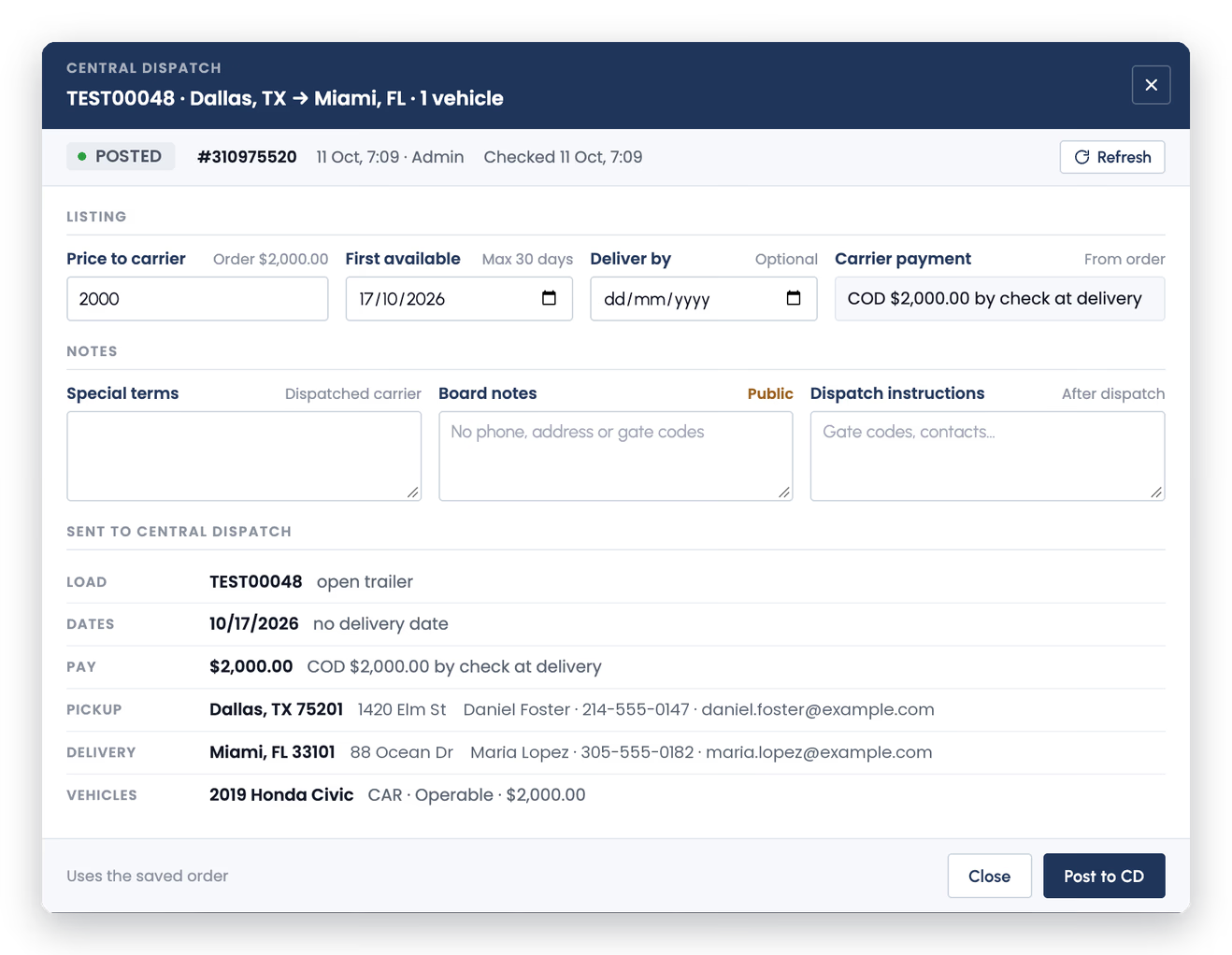
- Open your load board account. Central Dispatch is where most car carriers look for loads. Core costs $139.95 a month plus tax.
- Write your paperwork. A carrier agreement, customer terms with your cancellation and deposit policy, and an e-signature step so every booking is signed.
- Set up a system of record. You must keep a record of every brokered transaction for three years (49 CFR § 371.3). TruxCRM keeps the lead, quote, signed order, carrier and payments on one record, and posts to Central Dispatch from the order. It costs $120 a month for up to five agents, and you can book a free demo while your application is pending.
- Put the renewals in your calendar. The bond renews yearly, UCR is due before 1 January, and any change to your address, phone or ownership should go into Motus straight away.
Then learn to vet every carrier before you hand them a customer's car. Your authority covers you as a broker. It doesn't make a bad carrier a good one.
8. Frequently asked questions
Do I need a license to be an auto transport broker?
Yes. Arranging interstate car shipping for money makes you a broker under federal law, so you need FMCSA property broker authority, a $75,000 bond or trust, and a BOC-3 filing. The exception is selling as an agent for a licensed brokerage, under its name and authority.
How much does an auto transport broker license cost?
About $1,300 to $2,000 with good credit. That's the $300 FMCSA fee, a BMC-84 bond at roughly $900 to $3,000 a year, a BOC-3 filing at $25 to $100, UCR at $46 for 2026 or $55 for 2027, and an LLC at $50 to $500 depending on your state.
How long does it take to get broker authority?
Usually three to eight weeks. After your application is published there's a 10-day protest period, and your bond and BOC-3 must be filed before the authority goes active. Your financial security must be on file within 90 days of publication or the application is dismissed.
Is there a test to become an auto transport broker?
No. FMCSA doesn't test brokers and doesn't require a course. The license is a registration: a verified identity, the $300 application, the $75,000 financial security and a process agent.
Did MC numbers go away with Motus?
No. Motus replaced the old Unified Registration System as the place you apply, starting in May 2026. Broker authority still carries an MC docket number, and carriers and load boards still look you up by it.
Is a freight broker license the same as an auto transport broker license?
Yes. Both are FMCSA broker authority for property. A broker who ships cars and one who ships pallets file the same application, the same $75,000 security and the same BOC-3. Household goods brokering is a separate authority type.